How To Bake Sourdough Bread For The First Time
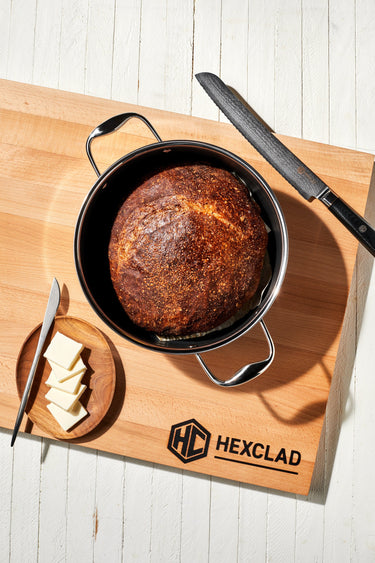
During the pandemic, it seemed like everyone was making their own bread. Then, time passed, the sourdough starters died, and flour was back on the shelves. You might be wondering, “what’s the fuss about? Is it really worth making my own bread?” Yes! Besides the satisfaction of having created a beautiful loaf that rivals any bakery, homemade sourdough is easy, inexpensive, and a great way to make use of your 5-quart Dutch oven.
Though making homemade bread isn’t hard, it does take some strategizing and a bit of time. That’s why we sat down with Melissa Gaman, the recipe developer responsible for HexClad’s Sourdough Boule recipe to get her tips to help you before making her recipe for this tangy loaf. It’s perfect for dunking into Brothy Tuscan Cannellini Beans & Greens or making into an epic Grilled Cottage Cheese Sandwich.
The first thing that Gaman points out is the uniqueness of sourdough. It’s not your everyday sandwich bread, she points out, “Sourdough is all about embracing the chewy, soft interior and the crispy, crackly crust. When people think about sourdough they don’t just think about the flavor, they think about the texture.”

Don't worry too much
“The first time you’re doing it, you don’t know what you don’t know.” Basically, Gaman says, it’s worth a test run, during which you simply try following the steps and not worrying if things seem unfamiliar. “Sourdough doesn’t act like anything else,” she says, and that’s the beauty of it. “Everybody’s loaf will look a little bit different. It has so much to do with people’s individual starter, that starter’s health, and the ambient temperature of the kitchen.”
The time varies
After preparing the dough (don’t worry if it looks soupy, says Gaman, that’s normal), you’ll start the bulk fermentation. This is the part where the dough grows in size. You’ll fold the dough every 45 minutes or so, but the temperature of the room and the level of the starter’s activity will determine how long it takes to get to the desired stage. How will you know if it’s working? Gaman says you’ll start to notice that there’s air in the dough. The idea is that you’re actually adding bulk and the dough is getting bigger.
Don’t stress if the dough is taking a while to double in size. Fold the dough per the recipe instructions as many times as it takes until it has doubled in size. The total time will vary. “Sometimes it’ll take 3 hours and the next it’ll take 6,” says Gaman. “In the winter, the kitchen is colder so it can take as much as double the time as in the summertime.”
Here’s what you’ll need to make homemade sourdough
- Bread flour: Because bread flour has a higher protein content, it gives better structure to the dough. If you use all-purpose flour, it will come out a little bit more cakey and more like sandwich bread.
- Whole wheat flour: This adds some earthy nuttiness and depth and helps counter the sourness of the sourdough.
- Rice flour: It’s key not to rip the shell that develops on the outside of the dough while it’s resting in the bowl (or shaping basket) on the towel. Rice flour (or any gluten-free flour) won’t absorb into the bread or stick.
- Salt: Gaman likes to use kosher salt, but you can put your HexClad Salt Mill to use, too. Use about half the salt, but adjust it to a medium-coarse setting.
- Active sourdough starter: You can buy mature starters online (or maybe find a sourdough evangelist who wants to gift you some of theirs). Keep it in the fridge if you don’t bake regularly and feed and discard it regularly.
Tools needed
- A flexible bench scraper: This wide, flexible spatula helps you move the dough in a single motion, protecting the structure you’ve worked hard to build.
- Lint-free kitchen towel: When shaping the dough in the bowl, you’ll want something that won’t stick to the exterior of the dough.
- Medium and large glass bowls: These allow you to see around the sides and the bottom to know whether the dough is at the right stage
- 5 QT HexClad Dutch Oven: Your Dutch oven really can do it all! Placing the pot in the oven before you bake the dough helps set the crust quickly.
- Small baking sheet: To mimic the heavy duty ovens of bakeries, add a baking sheet underneath the pot, which helps maintain an even temperature.